I have written before about Frédéric Bourdin, the Frenchman who for several months successfully passed himself off as a kidnapped American teenager, living supposedly undetected with the boy's family. Yesterday I saw the feature film based on this story, The Chameleon, which was almost exactly what I would have expected based on the story I had already read. It raised all the same questions about this story that I've read (and asked)before: how on earth could an entire family mistake a 25-year-old Frenchman for their 16-year-old relative? If they couldn't, why were they pretending to? Whose lies were worse, the impostor's or his adopted family's?
I, like the film, am pretty certain that at least some members of Nicholas Barclay's family know what happened to him, but I was surprised to see this "review" on Netflix:
This movie is based on my family and is a far cry from the truth of what really happened. Based on real life??? Not really! My family is against this movie.
The review is not signed, so we have no way to know whether it was really written by a family member, but I wonder what parts the family member objected to most. Did Bourdin resemble Nick Barclay more than the film and news article suggest? Were the family's character flaws fabricated for entertainment purposes? Despite Netflix's description of the film, it was in no way a "thriller," and exhibited few characteristics of a typically highly manipulated "Based on a True Story" film. I'd love to know what its inaccuracies are; that knowledge might give this bizarre story some closure!
Showing posts with label film. Show all posts
29 August, 2011
21 August, 2011
On Women and Fraud (first of a potential series)
I was excited to see the title Confidence Girl as an option to watch instantly via Netflix, because I've rarely found a film in which a woman was running a con or perpetrating fraud on her own. I probably should have expected less, because despite the film's title, the titular character seems in no way to run anything and is decidedly not on her own. In fact, if anything, she is the movie's moral redemption, and her only independent actions involve giving herself up to police. We could dismiss Confidence Girl as a typically sexist 1950s Hollywood film ("she'll take you for all you've got and you'll love it!"), but I suspect ther is more to this than socially-sanctioned sexism.
In fact, I suspect there is a lot more. Though women seem to lie, cheat, and steal as much as men do, there appear to be far fewer famous female forgers (say that five times fast!) and impostors than there are male ones. I'm so far afraid to conjecture a reason for this and I don't even have stastistics to prove it, but I've been mentally developing a project (dare I say paper or even dissertation?) that will help realize some of my ideas. Stay tuned for updates!
18 August, 2011
On Evil Twins and (Un)Successful Imposture
Yesterday I somewhat unintentionally watched two films with very similar premises, about people who commit crimes against their exact doubles in order to improve their own lives in one way or another. The two films are, of course, wildly different in their respective characterization, plots, and perspectives, but they both answere the age-old question "can I replace my exact double?" with a resounding "NO!" Bette Davis thinks she is very successfully impersonating her rich twin sister though several people see right through her, and Chick's friends and acquaintances in The Man with My Face can almost immediately spot the impostor. Perhaps it's not as easy as this to spot fakers in real life, but maybe the most successful impostors are without close friends or relatives and thus have no one to give them away. Bette Davis's character in Dead Ringer is certain that she's "all alone" and the realization that she's not is both her emotional savior and legal undoing. Is the best impostor incapable of forming close relationships? Does he avoid them? Perhaps The Talented Mr. Ripley answers some of these questions, but I'll leave that for another day.
10 August, 2011
On Pecuniary Emulation, Product Placement, and Film
I've just seen the 2009 film The Joneses, about a marketing company that employs groups of people to act as families in order to sell everything they own, eat, and do to their well-off neighbors. The idea is nothing new, of course: I've just been re-reading The Theory of the Leisure Class by Thorstein Veblen, who in 1899 wrote that "the currently accepted legitimate end of effort becomes the achievement of a favourable comparison with other men; and therefore the repugnance to futility... coalesces with the incentive of emulation." I can almost imagine that the characters read Veblen as part of their training (which would have been nice to see in the film, perhaps).
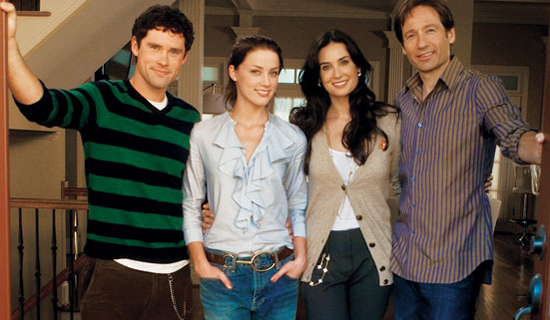
The title of the film itself is, of course, a nod to the phrase "keeping up with the Joneses," and in some ways it does critique a society which seems to prize possessions above all else, and the costlier, the more prized. The movie does take a tragic turn as a direct result of this "pecuniary emulation" (to coin Veblen again), and certainly the satire does, at times, come through to the viewer. However, at least as much as The Joneses tried to satirize a love for things over human relationships, it also actually attempted to sell us the products supposedly being critiqued. At one point in the film, David Duchovny's "son" says "doesn't it bother you that we're lying to them?" and Duchovny replies with "I'm not lying, I LOVE this car!" The movie is ultimately little more than one big advertisement for Audi, Ethan Allen, HTC, and dozens of other products the "Joneses" are very happily consuming and selling. It seems to me that a satire would be better served by use of products that don't actually exist in real life, and that this movie is at least as insidious as its characters by pretending to make fun of what it is actually trying to sell to its viewers. I felt slight outrage (while secretly wanting an Audi for myself), and my only consolation in all of this is that the film made far less at the box office than it cost to produce.
10 July, 2011
Acting as a Liar
22 June, 2011
Ruminations on Miscellaneous Forgeries
A few bits of information have been knocking around in my head, but I don't think each of them warrants its own individual post right now.
Wine Forgery:
A recent story in The Economist discusses a recent surge in forgeries of astronomically expensive wines, such as 1982 Chateau Lafite, by buying empty bottles and filling them with similar, but less expensive wine. I also came across this subject on a recent episode of Law and Order: Criminal Intent, so it must be happening quite frequently. The article equates this to art forgery, and I see the similarity, but since wine is produced for consumption, I relate less readily to victims of wine forgery. I am no wine connoisseur, let alone a wine collector, but it seems to me that wine collecting is a special form of avarice, so I'm not so likely to condemn wine forgers who fake the most expensive wines.
Peter Sellars and Crime:
Last night I watched the 1966 Peter Sellers film, After the Fox, in which a thief/con man pretends to be a film director in order to smuggle millions of dollars of gold bars into Italy. The movie (the real one, not the one the character creates) is rife with racial and cultural stereotypes that contribute to it being not especially good in general, but I enjoyed the premise of pretending that something real is fake. In one scene, the chief of police of the small town in which the phony film will be made is convinced to play a policeman in the film because it "won't be acting," which he couldn't possibly do because he is "not an actor." Sellers' character seems to own no real clothes, but only costumes, and when he is re-imprisoned at the end of the film, it is assumed that he has traded places with the doctor (who happens to be his doppelganger) until he tugs at his false beard and finds that it is, in fact, real. "The wrong man has escaped!" finishes the film, suggesting that the Sellers character himself has lost track of who he actually is. The movie was mostly ridiculous, but really right up my alley.
Wine Forgery:
A recent story in The Economist discusses a recent surge in forgeries of astronomically expensive wines, such as 1982 Chateau Lafite, by buying empty bottles and filling them with similar, but less expensive wine. I also came across this subject on a recent episode of Law and Order: Criminal Intent, so it must be happening quite frequently. The article equates this to art forgery, and I see the similarity, but since wine is produced for consumption, I relate less readily to victims of wine forgery. I am no wine connoisseur, let alone a wine collector, but it seems to me that wine collecting is a special form of avarice, so I'm not so likely to condemn wine forgers who fake the most expensive wines.
Peter Sellars and Crime:
Last night I watched the 1966 Peter Sellers film, After the Fox, in which a thief/con man pretends to be a film director in order to smuggle millions of dollars of gold bars into Italy. The movie (the real one, not the one the character creates) is rife with racial and cultural stereotypes that contribute to it being not especially good in general, but I enjoyed the premise of pretending that something real is fake. In one scene, the chief of police of the small town in which the phony film will be made is convinced to play a policeman in the film because it "won't be acting," which he couldn't possibly do because he is "not an actor." Sellers' character seems to own no real clothes, but only costumes, and when he is re-imprisoned at the end of the film, it is assumed that he has traded places with the doctor (who happens to be his doppelganger) until he tugs at his false beard and finds that it is, in fact, real. "The wrong man has escaped!" finishes the film, suggesting that the Sellers character himself has lost track of who he actually is. The movie was mostly ridiculous, but really right up my alley.
23 May, 2011
The Truth is Out There...Really, Really Out there.
Over the weekend I attended the U.S. Premier of a documentary called THE TRUTH IS OUT THERE, perhaps not surprisingly starring and co-produced by Dean Haglund of X-Files and The Lone Gunmen fame (and directed by Phil Leirness). The film explores conspiracy theorists and theories, and although this subject does not exactly fit with that of my blog, I figure I can stretch it to the dimensions of my interests.
The film mostly consists of a cleverly cut together series of interviews between Dean Haglund and various conspiracy theorists from around the world (mostly North America and the U.K.), in which for the most part Dean Haglund simply lets the theorists talk to him about their theories. These theories cover UFOs and aliens (including alien-human hybrids), crop circles, food production, government, banking systems, angels, the military, 9/11, consciousness itself, and probably several other topics I've already forgotten about. Rather than passing judgment on any of the theories, the film (and Dean Haglund) lets the theorists speak for themselves and the audience make its own judgments; of course the audience laughed at various figures on the screen, but I imagine that a different audience would laugh at completely different interviews. The ultimate effect, then, was not one of ridicule as I had expected, but of contemplation and even acceptance to some extent. In a way, I realized that I, too, was a conspiracy theorist.
But of course I am always thinking about truth and lying, so while watching the film I often considered the sincerity of the characters on the screen. From my perspective, every person interviewed in the film was completely sincere, whether he talked about consorting with angels, seeing UFOs, or destroying cancer cells with apple seeds. Although most of the country would agree that most of the theories probably aren't verifiable, no one in the film really thought she was making something up. Phil Leirness mentioned that one woman, who believed she was an alien-human hybrid, was one of the nicest people he had ever met and someone he would trust to look after his pets. Are these conspiracy theorists harmless wackos who can be left to their own devices? Should people try to convince them that what they believe is not the truth? Or must we all just realize that truth actually is subjective and there's no hope for anyone believing anyone else's truth, so we should all just live and let live?
I'm not sure I've really given a review of this film, just as I'm not sure I've come to any conclusions about it or conspiracy theories or truth. A second film with the subtitle "Ancient Knowledge" is forthcoming, and I look forward to watching that as well. I welcome any comments and questions.
The film mostly consists of a cleverly cut together series of interviews between Dean Haglund and various conspiracy theorists from around the world (mostly North America and the U.K.), in which for the most part Dean Haglund simply lets the theorists talk to him about their theories. These theories cover UFOs and aliens (including alien-human hybrids), crop circles, food production, government, banking systems, angels, the military, 9/11, consciousness itself, and probably several other topics I've already forgotten about. Rather than passing judgment on any of the theories, the film (and Dean Haglund) lets the theorists speak for themselves and the audience make its own judgments; of course the audience laughed at various figures on the screen, but I imagine that a different audience would laugh at completely different interviews. The ultimate effect, then, was not one of ridicule as I had expected, but of contemplation and even acceptance to some extent. In a way, I realized that I, too, was a conspiracy theorist.
But of course I am always thinking about truth and lying, so while watching the film I often considered the sincerity of the characters on the screen. From my perspective, every person interviewed in the film was completely sincere, whether he talked about consorting with angels, seeing UFOs, or destroying cancer cells with apple seeds. Although most of the country would agree that most of the theories probably aren't verifiable, no one in the film really thought she was making something up. Phil Leirness mentioned that one woman, who believed she was an alien-human hybrid, was one of the nicest people he had ever met and someone he would trust to look after his pets. Are these conspiracy theorists harmless wackos who can be left to their own devices? Should people try to convince them that what they believe is not the truth? Or must we all just realize that truth actually is subjective and there's no hope for anyone believing anyone else's truth, so we should all just live and let live?
I'm not sure I've really given a review of this film, just as I'm not sure I've come to any conclusions about it or conspiracy theories or truth. A second film with the subtitle "Ancient Knowledge" is forthcoming, and I look forward to watching that as well. I welcome any comments and questions.
28 February, 2011
All About Lies
One of my favorite movies of all time is All About Eve. There are many reasons to love the film: Bette Davis, witty banter, costumes by Edith Head; none of these reasons make my love for it appropriate to this blog. All About Eve is about misguided trust, about the ease with which a pretty girl can get anything she wants through lies and treachery, about the difference between acting and lying. The best actors (or is it the best liars?) seem to catch on to Eve's deceit early in the film, but the non-actors are more naive and thus truly shattered by the revelation of her lies. Eve only speaks in truth when she talks of acting in front of a theater:
They want you. You belong. Just that alone is worth it.
A running trope of life-as-play runs through the film, but it seems that only Eve takes the idea seriously. Eve's an actress from the start whose life is a fictional play. She wins because she has no life separate from her act; she nullifies any true self to fake her way into the theater, to "belong" at any cost.
I've not done this film justice in my discussion, but I doubt this will be the last time I have something to say about this film and others like it. I encourage commentary.
03 February, 2011
Documentary and the Truth
I saw the film Exit Through the Giftshop several months ago in theaters, but it's just begun to get more attention due to both its video release and recent Oscar nomination. The documentary follows a French expatriate obsessed with filming himself doing everything from shaving in his bathroom to scaling buildings in the name of radical street art. Despite its fairly sophisticated commentary on the economic and political value of art, the artistic merits of graffiti, and the stupidity of the general public, the film seems notable to most people for its dubious authenticity. Is there really such a person as Thierry Guetta? Is he really this moronic? Has he really duped Los Angelinos into buying his terrible art, or is the whole thing a stunt created by Banksy (pictured above) in order to piss on (or off?) art connoisseurs and the general public?
Though I rarely say this in my blog, I feel that the viewer misses the point if he looks for the line between truth and fiction in this documentary. Whether or not Thierry Guetta is real, tons of the terrible pseudo-street quasi-pop art by "Mister Brainwash" was viewed and sold at an exhibition in Los Angeles. The crazy Frenchman subject of the film is annoying/unbelievable/interesting whether he is made up or not. The point is still that most people who buy art are following ridiculous fads and that it is extremely easy for people like Banksy to exploit those people. Banksy is prosecuted for the free art he puts on public walls, and paid millions of dollars for essentially the same art placed in private spaces. I'm not necessarily entirely on Banksy's side in this matter, but I agree that the question of Guetta's existence/authenticity is not the main one here.
14 January, 2011
Layers of Fake
Orson Welles's last finished movie is the anomalous pseudo-documentary F for Fake that I need to see at least one more time in order to make a complete analysis. The film involves, among others, notorious art forger Elmyr de Hory, his biographer and fellow faker Clifford Irving (whose story involving the fabricated autobiography of Howard Hughes is told in the film The Hoax starring Richard Gere), and Orson Welles himself, who variously purports to tell the truth "strictly based on the available facts" and confesses to falsehoods while simultaneously creating others. The result is less illuminating than further confounding; rather than fully expose de Hory and Irving's lies, Welles appears in some sense to join forces with them or even attempt to beat them in some sort of faker competition.
The film gives an odd sense that fraud has a sort of viral quality, that either exposing fraud turns the exposer into a fraud himself, or that only fakers can see the falsehoods of others. I wonder to what extent the exposer of fraud feels he has power over the exposed, even that his exposé allows him to then commit his own frauds. It's difficult for me to discern truth from lies in a film that lies about telling the truth and lies about lying to its viewers, and perhaps this is the point. I'm comfortable with fiction because it does not say it is truth, but F for Fake, which seems to flip-flop the ideas of truth and fiction with varying amounts of success, makes me all sorts of uncomfortable.
03 January, 2011
On the Creepy Film Double
However, I understand the sinister quality of the idea that one could be replaced by some sort of impostor. We all want to believe that we are unique, and that we are in particular careers or relationships because we are uniquely qualified to be in them. We are also afraid that this is not the case; we worry that some impostor could replace us, or even worse, that we are impostors and could be replaced by the legitimately unique and qualified versions of us. Black Swan used ballet to mostly successful effect (though I'm sure ballerinas are going to be livid!), and I'm going to be looking for my doppelgangers everywhere now.
Subscribe to:
Posts (Atom)